
Operational Systems Diagnostic
Identify the operational waste slowing down your SaaS company and design the systems needed to eliminate it.
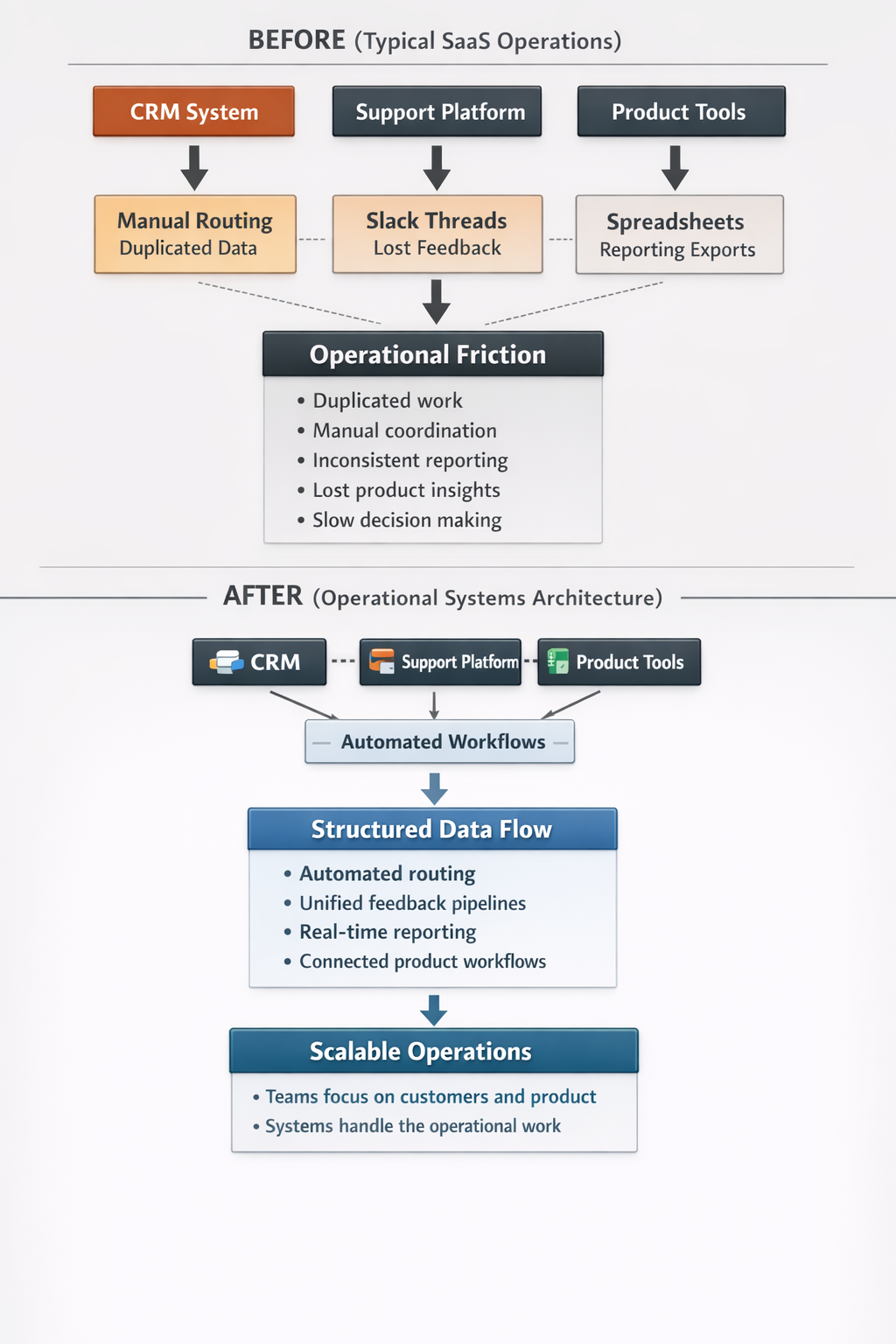
Most growing SaaS companies rely on dozens of tools to run their business.
CRM platforms, support systems, product tools, reporting dashboards, analytics platforms, and internal workflows all operate simultaneously.
Individually, these systems work.
But the workflows between them are often manual, fragmented, or invisible.
The Operational Systems Diagnostic maps how your business actually operates and identifies the operational infrastructure needed to scale efficiently.
Who This Is For
This diagnostic is designed for SaaS companies that are experiencing operational friction.
Your team may benefit from this diagnostic if:
• Leads are routed manually between systems
• Customer feedback is scattered across multiple tools
• Reporting requires exporting spreadsheets every week
• Product teams struggle to consolidate feedback into roadmaps
• Data is duplicated across systems
• Operational workflows depend on manual coordination between teams
If your team spends significant time managing tools instead of running the business, the diagnostic will reveal where operational waste exists.
What we uncover during the diagnostic
The goal of the diagnostic is to reveal the hidden operational architecture of your business.
During the process, we identify:
Workflow Bottlenecks
Where manual work slows down operations.
Operational Waste
Where time and resources are lost to inefficient processes.
System Disconnects
Where tools fail to communicate effectively.
Data Fragmentation
Where information is duplicated or lost across platforms.
Automation Opportunities
Where systems can replace repetitive manual work.
Diagnostic Deliverables include:
Workflow Maps
Visual diagrams showing how work currently flows across your systems and teams.
Operational Waste Analysis
A breakdown of where manual processes consume time and resources.
Systems Architecture Diagram
A blueprint showing how your tools should connect to support efficient operations.
Automation Opportunity Map
Specific workflows that can be automated.
ROI Estimate
Estimated time and cost savings from implementing the recommended systems.
Implementation Roadmap
A prioritized plan for improving operational infrastructure.
How the process works
Step 1 — Discovery
We review your current systems, workflows, and operational challenges.
Step 2 — Workflow Mapping
We map how work actually flows across your tools and teams.
Step 3 — Systems Analysis
We identify operational bottlenecks and infrastructure gaps.
Step 4 — Architecture Design
We design the system architecture required to eliminate operational friction.
Step 5 — Diagnostic Delivery
You receive a full diagnostic report and implementation roadmap within 10-14 working days.
Investment
Custom engagement based on company complexity.
Most diagnostics fall between $3,000 and $6,000.
After the diagnostic
Some teams use the diagnostic as a roadmap for internal improvements.
Others engage Brass Tactics to implement the operational systems identified in the report.
Implementation engagements typically focus on:
• product operations infrastructure
• revops workflow automation
• support operations systems
• cross-platform reporting architecture